Large-scale community and economic resilience will not be achieved through isolated funding, programs, or initiatives. It requires funders and organizations to work together- aligning capital, sharing responsibility, and investing in outcomes that no single actor can achieve alone.
CCFI brings together funders, intermediaries, and organizations to:
CCFI is working to move Canada from fragmented funding to a more coordinated approach by:
Enabling aligned, multi-funder investment strategies
Supporting community-led, multi-organization solutions
Developing shared standards, frameworks, and commitments
Building the infrastructure needed for sustained collaboration


This is not a pilot. It is a field-building effort.
Map and strengthen collaborative funding models across Canada
Establish shared practices that reduce friction and increase scale
Launch new funder collaboratives and coordinated strategies
Support the shift from isolated efforts to system-level outcomes


If you are a community or sector leader, this is a pathway to move from individual proposals to coordinated strategies that match the scale of the challenges you are working to solve.
If you are a funder, this is a pathway to invest alongside others with greater clarity, confidence, and impact.
CCFI is designed to make collaboration our norm.
Why Now
Canada’s most pressing challenges - poverty, workforce transitions, racism, democracy, and community resilience - are increasingly complex and interconnected. And yet much of Canada’s philanthropic landscape is still structured around individual grants to individual organizations. These approaches limit impact, scalability, and how far scarce dollars can go. Nonprofits, charities, and coalitions of people closest to the challenges are feeling the strain of limited dollars, and funders are overwhelmed by the demand for their limited dollars.
Coast to coast to coast, many funders and organizations are already working to meet this reality - collaborating across sectors, building multi-partner strategies, and focusing on systems change. What’s missing is the infrastructure to learn from these efforts.
Also coast to coast to coast are dozens and dozens of funders not yet engaged in collaborative funding models but keen to. What’s missing is the infrastructure to surface where there are common interests and to turn those interests into new pooled funds.
Over the past year, through national conversations, convenings, and engagement across philanthropy and the charitable sector, a shared question emerged: How can capital in Canada be better aligned and deployed to achieve more the type of impact that no one organization can achieve on its own?
The Canadian Collaborative Funders Initiative (CCFI) is a direct response to that question.
This is not about more dialogue. It’s about bringing together people who want to align capital toward shared and transformational outcomes and building the structures, standards, and partnerships that will enable it.



The first stage of CCFI is being stewarded by three organizations working at the intersection of philanthropy, community leadership, and systems change: SETSI, Tamarack Institute, and Philanthropic Foundations Canada (PFC).
This collaboration is grounded in a history of work together.
Why Us
SETSI advances new models for an inclusive, resilient social economy – engaging and providing meaningful opportunities to the historically under-represented communities in the social economy, social finance, impact investing and cooperative ecosystems.
Tamarack Institute catalyzes collective action, supporting communities to move from connection to coordinated strategies that address complex challenges. For 25 years, we have been developing and deploying models that have contributed to hundreds of municipal, regional, provincial and territorial and national partnerships across nonprofits, funders, and other sectors.
Philanthropic Foundations Canada strengthens and connects the philanthropic sector nationally, enabling alignment across diverse funders.
CCFI will add to existing efforts by:
Surfacing and making visible existing examples of collaborative funding models – what they are and how they came to be
Convening funders to learn from each other about the approaches that are enabling collaborative funding models – and then to cohere those approaches into shared standards and commitments (and then into new collaborative funding models)
Convening nonprofits, charities, and other groups that are closest to the challenges to learn from each other about the approaches that enable cross-sector strategies for systemic change – and then to cohere these approaches into shared standards and commitments (and then proactive, irresistible change strategies that can be brought to funders)


We are not creating another initiative. We are inviting funders and organizations into a process to create the connections, trust and ultimately agreements that will move capital more effectively toward systemic change.
Table 2
Forging Shared Commitments Among Funders
To unlock the full potential of collaboration, we must create greater alignment with funders. This collaborative will identify the conditions, behaviours, and values that enable funders to pool resources effectively, align beyond individual mandates, and support shared outcomes while maintaining accountability.
Deliverables: A set of shared standards/commitments, best practices, and a formal agreement among participating funders, creating a more efficient and effective ecosystem for both grantmakers and grantees.

Table 3
Empowering Community-Led Ecosystem Proposals
This collaborative focuses on strengthening the capacity of community organizations and place-based partnerships to move beyond isolated requests and present coordinated, ecosystem-level proposals. This empowers communities to become architects of their own solutions, with aligned funding following their lead.
● Deliverables:
o A framework for strategic partnerships that enables communities to present ambitious, cross-sector proposals for systemic transformation, backed by a funder coalition ready to respond.
o A capital pathways map that provides a clearer view of types of capital available and how organizations can access and combine them.
Methodology: Networked Listening & Collaborative Sensemaking
To deepen understanding of the system we are exploring, we propose a participatory, network-based methodology that combines distributed inquiry with collective sensemaking. This approach is designed to surface diverse perspectives, identify patterns across experiences, and build shared ownership of insights. Key steps would include: designing a shared inquiry framework, conducting a series of system leadership listening interviews, synthesis & insight harvesting, collaborative sensemaking sessions, validation & iteration, and outputs & knowledge mobilization.

Setting the Stage for Action (2027 and beyond)
The collaborative tables are the starting point for further action. Beginning in December 2026, phase 2 would focus on building off this foundational work to run 2-3 new funder collaborative pilots and 2-3 new portfolio approaches, putting the learnings and standards into practice.
Opportunities for Funders to Engage
This initiative offers opportunities for both live participation (convenings, working groups, pilots) and synchronous engagement (feedback, insight sharing, review of outputs).
We are also inviting a small group of founding and supporting funders to help resource and shape this work. There are opportunities to support at several levels:
1 lead founding partner ($100,000/year, two-year commitment)
4 co-creators ($50,000)
4 collaborators ($25,000)
10 contributors ($5,000)
= $550,000 over two years
Funders will have multiple opportunities to engage in the ongoing work including:
Participation in the funder table and direct engagement with other leading funders and system leaders. Learning from and with others that are active in this space.
Highlighting their own best practices and examples of successful collaborative funding models
Shaping all project deliverables including the shared standards/commitments, playbook and toolkits, and capital pathway mapping. Input can be provided asynchronously, through live 1:1 conversations, and via the funder table.
Strategic influence on CCFI’s direction and priorities
Early participation in pooled funding or place-based pilots
Invitations to webinars and sector briefings
Early access to all publications (e.g. reports, playbook and frameworks)
All partners will be recognized (indicating their level of support) on the initiative’s landing page, published outputs, and communication materials.
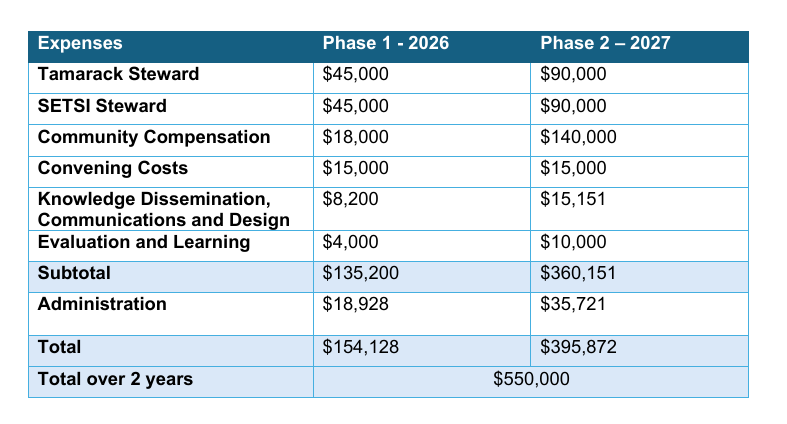
Appendix: Phase 1 & 2 Budget & Budget Narrative (May 2026 – Dec 2027)